A research exhibition · Honghe, Yunnan
How a Railway
Became One Station
Heritage, power, and uneven memory along the Yunnan–Vietnam Line
Read the full research paper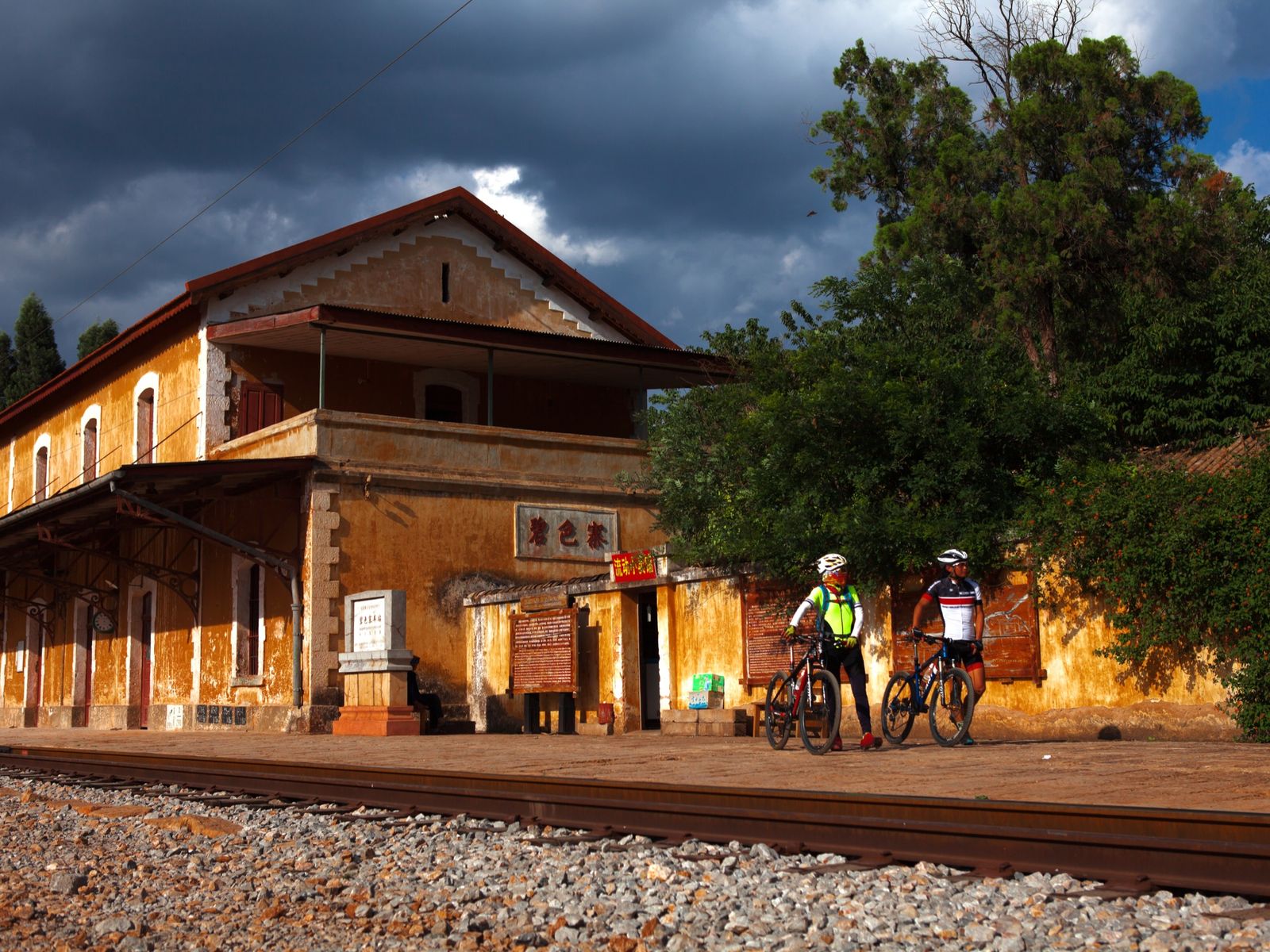

The question
Which station can stand for a railway?
“I argue that Bisezhai became more famous and representative because its history could be concentrated in a bounded, photogenic site, while Kaiyuan’s historical importance and influence were dispersed across the city.”
From the author's research paper, How a Railway Became One Station
The research paper
How a Railway Became One Station
Heritage, Power, and Uneven Memory along the Yunnan–Vietnam Line
The Yunnan–Vietnam Railway is a French-built metre-gauge railway connecting the Vietnamese port of Haiphong with Kunming in southwest China. It was an important route for exporting local natural resources. Today, Bisezhai Station, commonly known as the “Eastern Little Paris” or the “No. 1 Station on the Yunnan–Vietnam Railway,” has become a well-known and recognizable Chinese landmark, especially after appearing in the 2017 blockbuster Youth. During my fieldwork in Honghe Prefecture, however, a private railway curator in Kaiyuan told me that much of Bisezhai’s fame came from invented stories and rumors and that Kaiyuan had been the actual center of the railway. Inspired by his challenge to common perceptions, I examined museum exhibitions, travel writing, oral histories, official reports, and disputed local memories. Drawing on Michel-Rolph Trouillot, Laurajane Smith, and Brian Larkin, I argue that Bisezhai became more famous and representative because its history could be concentrated in a bounded, photogenic site, while Kaiyuan’s historical importance and influence were dispersed across the city. The process of creating heritage therefore reorganized local geography by making certain types of history more visible than others.
Follow the investigation
From a local challenge to a question about heritage
An encounter in Kaiyuan
During a museum visit, the curator's opinion challenged the premise of the official narrative.
Read the encounter 02Test the records
My research began with comparing the curator's claims with primary sources, and later I dived into the story looking for more details.
Examine the evidence 03Two kinds of centrality
the two forms of centrality of Kaiyuan and Bisezhai coexist, while one of them is more visible than the other
Compare the places 04Make a site representative
To preserve and present the railway, institutions must choose sites through which the network can be imagined and represented.
Follow the process